
Investment update: What goes up must come down… maybe?
With fingers tightly crossed, nine months into 2026, we are heading towards another year of incredibly positive market returns as illustrated by a range of market indices:

The UT Mixed Investment 0-35%, 20-60%, and 40-85% shares provide a suitable indication of diversified portfolios and show year-to-date returns of 3.50%, 5.89%, and 8.53% respectively. Annualised, this amounts to around 4.2%, 7%, and 10.2%.
Over one year in isolation, these numbers are not unusual, albeit higher than typical averages for the risk levels being taken. However, when this has followed double-digit stock market returns since 2023, it raises an important question: what next?
What brought us here?
Before we consider the future, let’s reflect on a brief monetary history since early 2020:
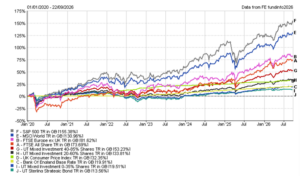
You will need little reminder of the events in 2020, when Covid-19 entered our language. We all recall the impact on stock markets, which saw a fall of around 30% in early March 2020. This was a time when every aspect of our lives was impacted, and investment market performance was understandably secondary to our collective concerns.
Various measures were introduced by central governments around the world, aiming to prop up the global economy. Examples in the UK included furlough schemes, government loans to businesses, and “eat out to help out” incentives.
Together with the effective printing of money (quantitative easing), these initiatives were all intended to maintain and stimulate our monetary systems. Vaccination progress coupled with the monetary stimulus saw stock markets recover by September 2020.
With hindsight, it is now recognised that too much stimulus provoked high inflation, peaking at 11.1% in the UK in October 2022. Central banks around the world tackled the inflation problem with a range of methods, including increasing interest rates and tightening money supply (quantitative tightening).
This chart shows the interaction in the UK and US between inflation and interest rates, illustrating the success of bringing inflation nearer to targets (2% in the UK and the US).
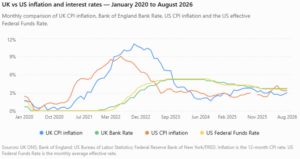
By the end of 2023, the markets perceived that inflation was back under control and would be followed by a lowering of interest rates, which encouraged share prices to rise again. This, combined with the expectations of increased future profitability from the advancement of artificial intelligence (AI), has sustained positive market conditions through to the current time.
Back to 2026
While inflation is significantly lower than the levels in 2022 and 2023, it has proven to be quite sticky, not helped by higher energy costs due to the Russian invasion of Ukraine and the continuing troubles in Iran.
The expectation for lower interest rates has given way to higher rates again. Rates were hiked to 3.75%–4% from 3.5%–3.75% by the Federal Reserve in a unanimous decision, despite fierce opposition from President Donald Trump, who had called for rates to be cut.
Closer to home, the Bank of England (BoE) held rates at 3.75% on 17 September, although three of the 10 members voted to increase them to 4%.
There has been much discussion of the next phase and expectations in relation to AI.
The BBC reported last month on global borrowing costs and the relationship between higher oil prices and AI, which is well worth a read.
We have seen the income yield on fixed-interest and government debt increase due to the higher interest rate expectations, which lowers the capital value of the underlying securities.
What next?
Inflationary pressure, the potential for interest rates to move higher rather than lower, and the sustainability of hyperscaler AI capital expenditure are the principal macro risks we face currently.
Directly linked to inflation, and therefore interest rates, is the risk of further escalation in Ukraine and Iran, amongst others. If the AI hype cycle were to unwind, the impact could be very damaging in the short term.
However, most of these concerns are not new and were just as valid coming into 2026. Had we taken an extreme position of heading to cash after 2025, we would now be having potentially awkward conversations with some clients who had missed out on the returns so far in 2026.
What to do?
HarperLees’ role as financial planners is to step away from the noise and aim to guide you through the good and the more difficult investment periods, while not losing sight of the longer term. This is why it is so important to continually assess the market sensitivity of your financial plan to ensure you remain on track.
Our approach remains to diversify our clients’ portfolios and not attempt to second-guess what may happen next by taking extreme positions. History has shown that this brings unnecessary risk, and we believe that remaining invested with a focus on the longer term brings a greater probability of success.
However, this is subject to two key criteria:
1. Your portfolio remains within an acceptable level of risk to meet your financial and lifestyle planning objectives without sleepless nights. If the latest negative news sends you immediately to check on your portfolio values, we recommend a discussion with your planner as soon as possible.
2. Profits are realised to ensure sufficient liquidity to meet any planned spending over the next year or so. If we retain sufficient cash and the market falls, we can avoid the need to make sales, limiting the recovery. Please contact your planner as early as possible if your spending needs have changed since our last review meeting.
However, please feel free to contact us at any stage if you have any concerns or questions.
Otherwise, we will happily accept the opportunity to benefit from continued positive returns where possible to “make hay while the sun shines!”
Get in touch
We’re happy to help with any financial matters. Please email us at info@harperlees.co.uk or call 01277 350560 to find out more.
Please note
This article is for general information only and does not constitute advice. The information is aimed at individuals only.
All information is correct at the time of writing and is subject to change in the future.
The value of your investments (and any income from them) can go down as well as up and you may not get back the full amount you invested. Past performance is not a reliable indicator of future performance.
Investments should be considered over the longer term and should fit in with your overall attitude to risk and financial circumstances.