
What next for investment markets in the light of geo-political uncertainty?
First, a spoiler alert – we don’t have an inside track on what will happen next! History has shown that making market predictions that attempt to time markets, or forgetting the principle of diversification by investing in the theme of the moment, can bring significant risks to your portfolio.
The fundamentals: How global events can shape the investment landscape
The geo-political risk is significant, with a rise in populist and right-leaning politics around the world. We’re still waiting for anything resembling a peace settlement in Ukraine or Gaza. Meanwhile, the internet shutdown in Iran means we cannot be sure what is actually happening and how that may play out in the region and its wider impact. And disputes with China and other countries in the Far East rumble on.
A driving force of returns in recent years has been the stellar performance of the ‘Magnificent 7’ companies:
-
- Alphabet
- Amazon
- Apple
- Meta
- Microsoft
- Nvidia
- Tesla
This was due to expectations of higher profitability from their use of artificial intelligence (AI). This has brought the risk of a pullback in prices and unhelpful comparisons to the technology stocks boom and bust in the early 2000s.
However, 2025 saw only two of the companies, Alphabet and Nvidia, providing higher than average returns against the S&P 500 index, which suggests that the heat may have reduced already.
Inflation is much lower around the developed world compared with the peaks of 2021/22, and this has contributed to the higher share values that have benefitted investment portfolios. However, there is still work needed to bring it under central bank targets, and as a result, the pace of interest rate reductions has slowed.
While US GDP has been more resilient than some might have expected in the face of tariffs, there are worrying signals from various data points. The US going into recession could wipe out market optimism globally.
The knock-on effect of a recession would be severe pressure on the US government. Tax income would fall, welfare spending would rise, and the budget deficit would be even bigger than it already is.
That could trouble bond investors and lead them to demand a higher return for the risk of holding US government bonds, i.e., we could see a bond market sell-off and Treasury yields would rise. That in turn could weigh on the high valuations of US tech stocks which populate so many investor portfolios around the world.
However, the US mid-term elections are set for 3 November, and the chances are they will become the usual protest vote that sees the incumbent party lose seats in the House of Representatives, the Senate, or both. Given the narrow Republican majorities in each, President Trump could lose control of at least one and find his room for policy manoeuvre constrained in the last two years of his term.
President Trump will no doubt be aware of this danger and his tactics have been to boost the US economy with a lower dollar, a lower oil price, lower interest rates, tax cuts, and deregulation. If this plan succeeds, and the combination of monetary and fiscal stimulus leads to upside surprises from US corporate earnings, then the S&P 500 could yet confound the historical pattern of a relatively quiet second year to a presidency.
What does this mean for the future?
Most of the geo-political risks have been around for a while, and markets have continued their rise regardless. While there are examples that could indicate a market fall is around the corner, there is also evidence which could argue there is still room for optimism.
Typically, the success when investing over the longer term comes from the daily incremental changes, with less impact from significant increases or falls. The core investment principle is that time in the market beats timing the market, as this chart illustrates:
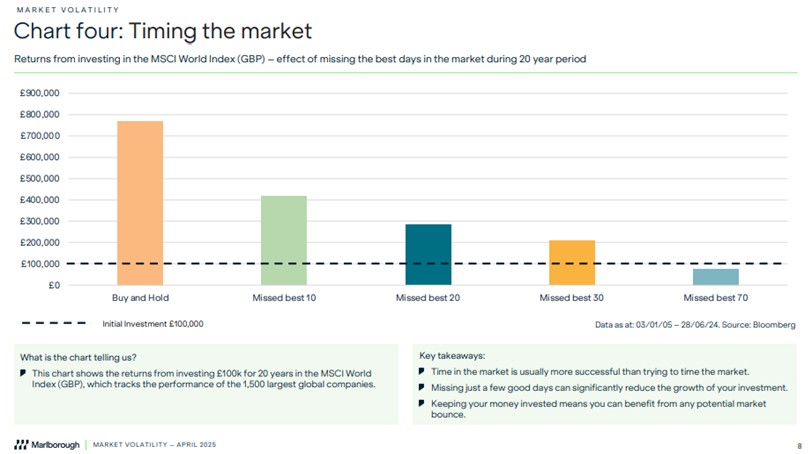
It illustrates that investing £100,000 in the MSCI World Index, which is a basket of shares from across the world over 20 years to June 2024, would have grown to almost £800,000. If market timing had been the strategy which had missed the best 10 days during that 20-year period, the same £100,000 would have delivered around £400,000. Missing the best 70 days would have seen a loss against the original £100,000.
That said, after three successive years of very strong growth, the law of averages alone could suggest we may see a pullback in prices in the not-too-distant future.
When markets fall, history has shown they always recover. However, the time for recovery is unpredictable. When markets fell in the wake of President Trump’s tariff announcements in April 2025, the recovery was swift and, as mentioned, was soon forgotten in the calendar year results.
Yet, we would never have realistically expected that position without the benefit of hindsight. Looking back, markets took around 2.5 years to recover from the financial crisis in 2008.
Our recommended approach is to keep calm and carry on
We believe that the most suitable strategy to navigate the market noise is to focus on the longer term. As such, for most situations, we recommend you stay invested with the long term in mind on condition that:
-
- The investment risk of your portfolio is in line with meeting your future objectives. You will know that from our cashflow planning updates.
- You don’t have sleepless nights if you cannot escape the often hyperbolic media portrayal of market falls. Remember, without the volatility of some days up, and some days down, we do not see the longer-term returns over cash and inflation.
If you’re drawing from your portfolio now, or planning to draw soon, it is prudent to take profits and hold them as cash. This mitigates the risk of needing withdrawals shortly after the market has fallen.
Get in touch
We are always happy to discuss and plan accordingly with you, so if you have any concerns or questions, please get in touch.
Please email us at info@harperlees.co.uk or call 01277 350560 to find out more, and we’ll be very happy to help.
Please note
This article is for general information only and does not constitute advice. The information is aimed at individuals only.
All information is correct at the time of writing and is subject to change in the future.